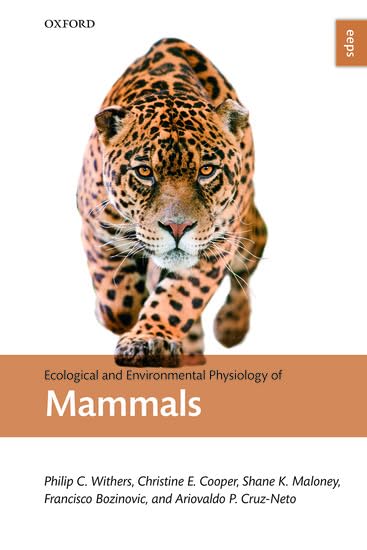
Ecological and environmental physiology of mammals / Philip C. Withers, Christine E. Cooper, Shane K. Maloney, Francisco Bozinovic, Ariovaldo P. Cruz-Neto.
Material type: TextSeries: Ecological and environmental physiology series ; v. 5.Publisher: Oxford : Oxford University Press, 2016Edition: First editionDescription: xv, 590 pages : illustrations ; 24 cmContent type:
 - text
- unmediated
- volume
- 9780199642717 (hbk)
- 0199642710 (hbk)
- 9780199642724
- 0199642729
- 590/ECO
- QL739.2 .W58 2016
| Item type | Current library | Call number | Copy number | Status | Barcode | |
|---|---|---|---|---|---|---|
 Books like text book referance book
|
Natural & Computational Science Library General Stacks | 590/ECO (Browse shelf(Opens below)) | 1 | Available | NSCLIB000015538 |
Browsing Natural & Computational Science Library shelves, Shelving location: General Stacks Close shelf browser (Hides shelf browser)
| No cover image available |

|
|

|

|
|
|
||
| 589.4/BHA ALGAE | 589.409/REY The ecology of freshwater phytoplankton / | 5894'0916/REY The ecology of freshwater phytoplankton / | 590/ECO Ecological and environmental physiology of mammals / | 590/GHO FUNDAMENTALS OF ZOOLOGY | 590/GHO FUNDAMENTALS OF ZOOLOGY | 590/GHO Fundamentals of ZOOLOGY |
Includes bibliographical references (pages 479-570) and index.
Introduction to mammals -- General physiological principles -- Physiological characteristics of mammals -- Physiological adaptations to extreme environments -- Concepts, approaches, techniques, and applications -- Conclusions and future directions.
Mammals are the so-called "pinnacle" group of vertebrates, successfully colonising virtually all terrestrial environments as well as the air (bats) and sea (especially pinnipeds and cetaceans). How mammals function and survive in these diverse environments has long fascinated mammologists, comparative physiologists and ecologists. 'Ecological and Environmental Physiology of Mammals' explores the physiological mechanisms and evolutionary necessities that have made the spectacular adaptation of mammals possible. It summarises our current knowledge of the complex and sophisticated physiological approaches that mammals have for survival in a wide variety of ecological and environmental contexts: terrestrial, aerial, and aquatic. The authors have a strong comparative and quantitative focus in their broad approach to exploring mammal ecophysiology. As with other books in the 'Ecological and Environmental Physiology Series', the emphasis is on the unique physiological characteristics of mammals, their adaptations to extreme environments, and current experimental techniques and future research directions are also considered. 0This accessible text is suitable for graduate level students and researchers in the fields of mammalian comparative physiology and physiological ecology, including specialist courses in mammal ecology. It will also be of value and use to the many professional mammologists requiring a concise overview of the topic.
There are no comments on this title.