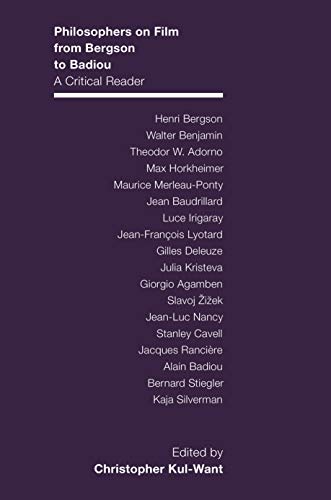
Philosophers on film from Bergson to Badiou : a critical reader / edited by Christopher Kul-Want.
Material type: TextPublisher: New York : Columbia University Press, [2019]Description: xi, 355 pages ; 25 cmContent type:
 - text
- unmediated
- volume
- 9780231176026
- 9780231176033
- 791.4301 23
- PN1995 .P4984 2019
| Item type | Current library | Collection | Call number | Copy number | Status | Barcode | |
|---|---|---|---|---|---|---|---|
 Books like text book referance book
|
Wondo Genet Library General Stacks | Reference | 791.4301 KAR 1993 (Browse shelf(Opens below)) | 1 | Available | WGCFNRL00013810 |
Includes bibliographical references (pages 341-347) and index.
Creative evolution, 1907 / Henri Bergson -- The work of art in the age of its technological reproducibility, 1935-36 / Walter Benjamin -- The culture industry: enlightenment as mass deception, 1944 / Theodor W. Adorno and Max Horkheimer -- The film and the new psychology, 1945 / Maurice Merleau-Ponty -- On contemporary alienation or the end of the pact with the devil, 1970 / Jean Baudrillard -- The looking glass, from the other side, 1977 / Luce Irigaray -- Acinema, 1978 / Jean-François Lyotard -- Cinema I the movement-image, 1983 / Gilles Deleuze -- Cinema II the time-image, 1985 / Gilles Deleuze -- The malady of grief: Duras, 1987 / Julia Kristeva -- Notes on gesture, 1992 / Giorgio Agamben -- "In his bold gaze my ruin is writ large", 1992 / Slavoj Žižek -- And life goes on: life and nothing more, 1995 / Jean-Luc Nancy -- Contesting tears, the Hollywood melodrama of the unknown woman, 1996 / Stanley Cavell -- From one manhunt to another: Fritz Lang between two ages, 2001 / Jacques Rancière -- Cinema as philosophical experimentation, 2003 / Alain Badiou -- Cinematic time, 2011 / Bernard Stiegler -- The analogy of photography, or the history of photography, part 1, 2015 / Kaja Silverman.
"Philosophers on Film from Bergson to Badiou is an anthology of writings on cinema and film by many of the major thinkers in continental philosophy. The book presents a selection of fundamental texts, each accompanied by an introduction and exposition by the editor, Christopher Kul-Want, that places the philosophers within a historical and intellectual framework of aesthetic and social thought. Encompassing a range of intellectual traditions--Marxism, phenomenology, psychoanalysis, poststructuralism, gender and affect theories--this critical reader features writings by Bergson, Benjamin, Adorno and Horkheimer, Merleau-Ponty, Baudrillard, Irigaray, Lyotard, Deleuze, Kristeva, Agamben, Žižek, Nancy, Cavell, Rancière, Badiou, Stiegler, and Silverman. Many texts discuss cinema as a mass medium; others develop phenomenological analyses of film itself. They reflect upon the potential of film to challenge dominant forms of ideology. The anthology considers the ways in which cinema can disrupt the clichés of capitalist images and offer radical possibilities for creating new worlds of visceral experience outside the grasp of habitual forms of knowledge and subjectivity. Ranging from the early silent period of cinema through the classics of European and Hollywood cinema to the early twenty-first century, the films discussed offer a vivid sense of these philosophers' concepts and ideas, casting new light on the history of cinema. This reader is an essential and valuable resource for a wide range of courses in film and philosophy"-- Provided by publisher.
There are no comments on this title.